


Stack Ball - Crash Platforms
CASUAL AZUR GAMES
I spent time with Stack Ball - Crash Platforms as the kind of game I would keep on my phone for short breaks rather than long, planned sessions. Its idea is immediately clear: guide a bouncing ball downward through a tower of rotating platforms while avoiding the sections that stop your progress. That simplicity is its biggest strength, but also the reason its appeal depends so much on whether you enjoy quick timing challenges and repeated attempts.
My overall impression is positive but specific. This is a polished-feeling arcade game for people who like instant controls, visible progress, and the satisfaction of turning a nearly impossible-looking stack into a clean descent. It is not the right choice if you want a story, character development, deep strategy, or a calm game with no interruptions. I found it most enjoyable in small doses, when I wanted something I could understand in seconds and play with one hand.
Why the one-touch idea works so well
The central interaction is easy to learn: I press and hold to send the ball through breakable platform sections, then release when a dangerous section is approaching. That creates a surprisingly active rhythm from a very small control scheme. I am not managing several buttons or learning a complicated move set; I am judging timing, watching the stack rotate, and deciding whether to continue the descent or wait for a safer opening.
The best moments come when several layers line up and I can maintain a long downward run. The ball gathers momentum through the stack, and the screen gives me a clear sense that one mistake could end the attempt. That risk-and-reward balance keeps the game from feeling like a completely automatic tapper. Even though the rules are simple, I still have to pay attention to the movement of the platforms and avoid rushing just because a gap appears.
I particularly like how quickly a failed attempt becomes understandable. When I lose, I usually know whether I held too long, reacted too early, or committed to a gap without checking what was beneath it. That clarity matters in an arcade game. A failure feels like something I can improve rather than a random punishment, which makes restarting feel natural.
Related News

Why WhatsApp Messenger Still Makes Everyday Communication Feel Easy

Jurassic World: The Game Is the Better Dino Tycoon for Strategic Players

Threads in Real Life: Who Should Join, Lurk, or Leave

How SHEIN Turned Shopping Into an Endless Content Feed

How to Make Fortnite Feel Smarter on Mobile

Should You Switch to Microsoft Outlook on Mobile?
The game is free to play, and that makes it easy to try without planning a purchase. It is suitable for Everyone, so the basic presentation is accessible to a broad audience. CASUAL AZUR GAMES has placed the title in the arcade category, where its short rounds and reflex-based design make sense. Its scale is also clear from its audience: it has passed over 500 million installs, and its average rating sits at 4.4, signs that the simple format has reached far beyond a small niche.
A useful game for awkward spare minutes
My favorite use case is a short waiting period when I do not want to start something that demands a full commitment. If I have a few minutes before an appointment, I can open the game, play several attempts, and stop without losing the thread of a story or leaving a team behind. The controls are especially convenient when I am holding the phone in one hand, although I still prefer to play while seated and focused rather than while walking.
That short-session design also makes it suitable for players who enjoy chasing personal improvement. I often found myself thinking, “I can do that section more cleanly next time,” even after a failed run. The challenge is not built around exploring a large map or collecting complicated resources. It is about building better timing and recognizing when patience is more valuable than speed.
Gallery
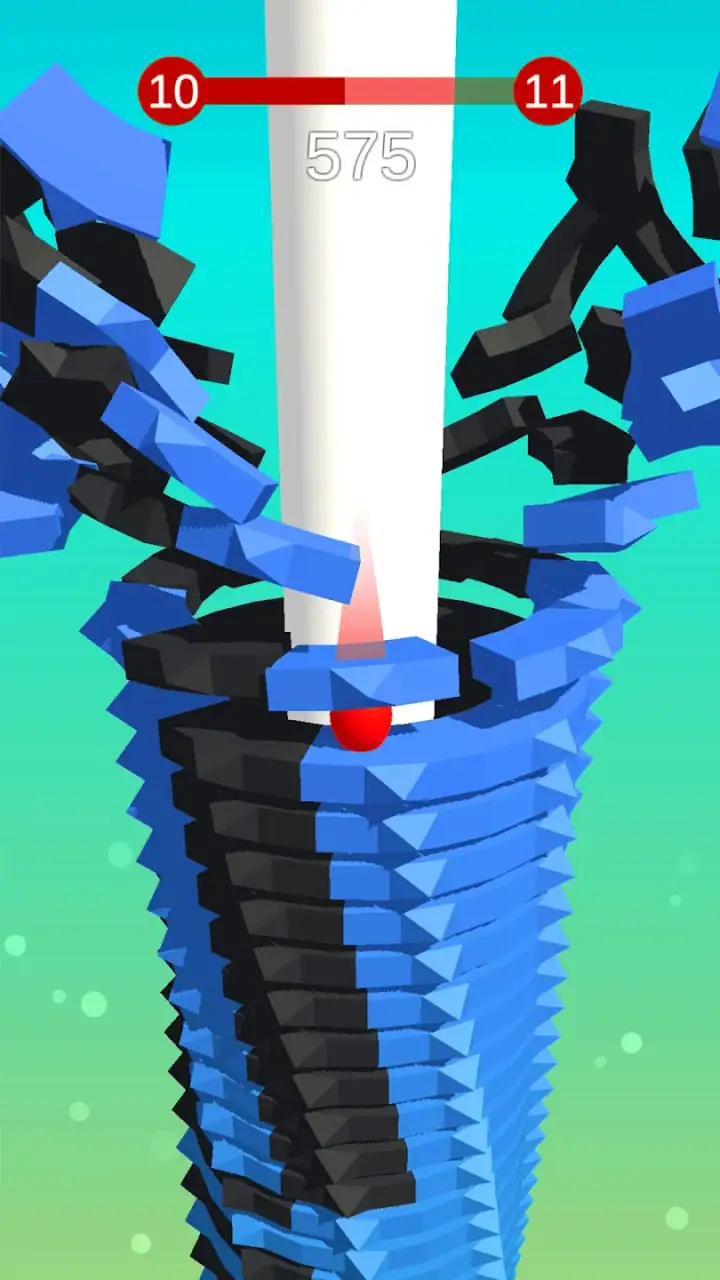
There is a subtle advantage in the way the tower keeps the action visually centered. I do not need to search around the screen for objectives, equipment, or menus while playing. The stack is the puzzle, the ball is the immediate concern, and the next safe opening is the only information that matters. That focus makes the game approachable for younger players and for anyone who does not usually play arcade titles.
Where the difficulty becomes more demanding
At first, I could rely on a fairly direct reaction: hold when the path looked open and release near danger. That approach stopped working once the stack became less forgiving. I learned to look beyond the first visible layer because a seemingly safe opening can lead directly to a hazardous section underneath. The practical tip is to treat each descent as a two-step decision: check the current opening, then quickly inspect what is coming next before committing.
Another useful habit is to avoid holding automatically through every breakable section. Continuous movement feels efficient, but it can make me lose control of the timing. Releasing briefly gives me a chance to read the rotation and choose a better entry point. This is one of the game’s more interesting trade-offs: speed can help clear a stack, but patience gives better information.
I also found that playing with a consistent grip helps. Because the game depends on holding and releasing, an unstable hand can create accidental inputs at exactly the wrong moment. When I play during a commute or while distracted, my mistakes feel less like failures of judgment and more like failures of control. In a quiet setting, the same sections feel much fairer.
The game’s simplicity does not mean every attempt feels equally satisfying. Some sessions become a loop of quick restarts, especially when I am tired or impatient. That is normal for a reflex arcade title, but it means the experience depends heavily on my mood. When I want to relax without pressure, a slower puzzle game is a better fit. When I want immediate interaction, this one has a stronger pull.
Free access and the friction around it
The free entry point is a clear advantage, but I would not describe the experience as completely frictionless. Like many free mobile arcade games, it is designed around repeated play and optional spending. In-app purchases range from $1.99 to $5.99 per item, so anyone who is sensitive to purchase prompts should keep that in mind before handing the phone to a child.
I do not think spending is necessary to understand the core appeal. The basic timing challenge is present without paying, and the game can work perfectly well as a casual download. However, players who dislike any interruption to a fast retry cycle may become frustrated. The more often I failed and restarted, the more noticeable every pause around the action became.
This is also where the title compares differently with paid arcade games. A paid alternative may offer a cleaner, more controlled presentation from the beginning, while this game has the advantage of being immediately available at no upfront cost. For me, the choice depends on tolerance: if I want to sample a quick arcade idea first, the free model is convenient; if I already know I dislike monetized mobile loops, a paid game may be more comfortable.
Parents should also remember that an Everyone age rating describes broad content suitability, not necessarily the best play environment for every child. The controls are simple enough for younger users, but the repeated retry structure can encourage “one more attempt” behavior. I would let a child try it, while still setting the same screen-time boundaries I would use for any highly repeatable arcade game.
How it compares with familiar arcade choices
Compared with endless runners, this game is less about steering across a wide path and more about reading a vertical sequence of immediate hazards. I do not need to make constant left-right corrections, but I do need to control the timing of a single repeated action. That makes it easier to learn than many runners, though arguably narrower for players who enjoy varied movement.
Compared with match-three games, it has almost no planning layer. There are no boards to study or combinations to prepare; the challenge happens in real time. I prefer this when I want my hands and eyes involved, but someone who enjoys thoughtful turns and the ability to pause over a decision may find the action too repetitive.
It also differs from precision platformers on consoles or dedicated handhelds. Those games often reward a larger vocabulary of movement, while this one concentrates the challenge into holding, releasing, and reading the stack. That focus makes it accessible, but it also limits the sense of mastery for players who want advanced movement techniques or a richer level system.
The comparison explains who will get the most from it. If your favorite part of arcade games is the instant restart and the feeling of improving one small mistake, this is a strong candidate. If you need a changing world, a long-term build, or a reason to return beyond beating your previous performance, the usual alternatives may offer more lasting variety.
What I would check before downloading
The game runs on Android devices using version 7.0 or later, which covers a wide range of phones but still makes the operating-system requirement worth checking on an older device. The current version is 1.2.22. I would also make sure the phone has a responsive touchscreen, because delayed or inconsistent touch input can undermine a game built around precise releases.
I would not download it expecting a narrative campaign or a substantial collection of strategic systems. The value is in the immediate loop: open the game, read the tower, make a timing decision, and try again. That can be exactly what a casual player wants, but it is important to set the right expectation before installing it.
I would also skip it if visual repetition quickly bothers you. The stack-based structure gives the game its identity, yet the same basic action remains at the center of every session. Variety comes from the arrangement and pressure of the descent rather than from a completely different activity. Players who need constant novelty may enjoy the first experiments and then move on.
Who should play it most
I recommend it to people who want a lightweight arcade game that explains itself without a tutorial-heavy introduction. It is a good match for short breaks, one-handed play, and anyone who enjoys improving through immediate feedback. The broad age rating and straightforward control scheme also make it easy to share with family members who may not play mobile games regularly.
It is especially suitable for a player who likes a little tension but does not want a complicated competitive system. Each descent asks for concentration, yet I never felt I needed to memorize a large rulebook. The game gives me a clear objective and lets my timing do most of the work.
I would be more cautious about recommending it to people who become frustrated by repeated failure, dislike free-to-play interruptions, or need a strong sense of progression. It is also not my first choice for a long evening of focused gaming. After a while, the same interaction can lose its freshness, and a more varied arcade or puzzle title may hold attention better.
My final verdict after repeated short sessions
Stack Ball - Crash Platforms succeeds because it understands the value of a single good idea. Guiding the ball through rotating platforms is simple enough to start immediately, but the timing becomes more demanding when I stop treating every opening as an invitation to rush. That small shift—from reacting to reading ahead—is where the game gains most of its depth.
Its weaknesses are equally clear. The repeated structure can become monotonous, free-to-play friction may interrupt the quick rhythm, and there is not much here for players seeking story or complex progression. Those are not minor details; they define the experience. I would choose another game when I want a richer world, a calmer pace, or a more substantial long-term goal.
For everyone else, I think it is worth trying precisely because the commitment is low. It is free, widely available, and easy to understand within a few seconds. My recommendation is to approach it as a compact reflex challenge rather than a full gaming destination. Used that way, it delivers satisfying bursts of concentration and enough “just one more try” energy to earn a place among the better casual arcade options.
FAQs for Stack Ball - Crash Platforms
What is the main objective of Stack Ball - Crash Platforms?
Stack Ball - Crash Platforms is a casual arcade game where the objective is to smash, bump, and bounce through revolving helix platforms to reach the end. Players control a ball that descends down a tower made of platforms, crushing them as it falls. The challenge lies in avoiding black platforms that can end the game.
Is Stack Ball - Crash Platforms free to play?
Yes, Stack Ball - Crash Platforms is free to download and play on both Android and iOS devices. However, the game includes in-app purchases and ads, which can enhance gameplay or remove ads for an uninterrupted experience. Players can choose to spend money to gain these extra features.
Does Stack Ball - Crash Platforms require an internet connection?
No, Stack Ball - Crash Platforms does not require an internet connection to play. This makes it a great option for offline entertainment. However, some features, such as ads or in-app purchases, may require a connection to function properly.
What are the key features of Stack Ball - Crash Platforms?
Stack Ball - Crash Platforms offers a variety of features including vibrant and colorful graphics, smooth and responsive controls, and an engaging gameplay loop that keeps players coming back. The game also includes various levels and challenges that increase in difficulty, providing a continuous and satisfying gaming experience.
Are there any strategies to succeed in Stack Ball - Crash Platforms?
To succeed in Stack Ball - Crash Platforms, players should focus on timing their taps to avoid black platforms while continuously smashing through the colored ones. Patience and careful observation are key, as rushing can lead to hitting the black platforms. Practicing precision and timing will help players advance further.
Pros
- Simple and addictive gameplay
- Vibrant and colorful graphics
- Easy to learn controls
- Quick and satisfying levels
- Offline play available
Cons
- Repetitive level design
- Intrusive ads between levels
- Limited power-ups
- No multiplayer mode
- Basic sound effects


